The Enigma of Reality: Seeing Beyond the Surface
Daniel Bikas
The Subtle Art of Finding Reality in a Persian Full-Silk Rug
What is reality? Is it what we see, what we perceive, or something concealed beneath the surface of our everyday experiences? Throughout human history, philosophers, scientists, and thinkers have struggled with this fundamental question. Despite centuries of intellectual exploration, reality remains an elusive concept, challenging our understanding of existence, perception, and truth. It is precisely this philosophical mystery that inspires The Enigma of Reality, a conceptual Persian full-silk rug by Daniel Bikas, transforming an ancient artistic tradition into an invitation to question the very nature of what we see.
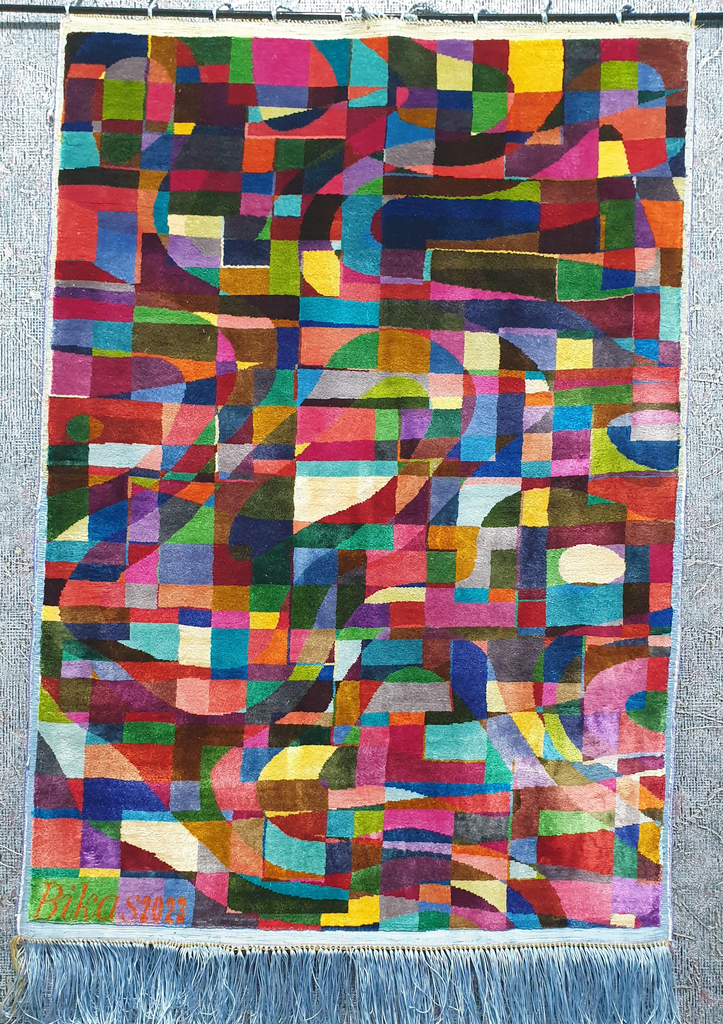
At first glance, the rug presents itself as a vibrant composition of intricate geometric shapes, interwoven in a sophisticated arrangement of colours and patterns. Its visual language is rich, energetic, and seemingly endless. Every geometric element connects with another, creating a harmonious yet complex tapestry in which individual forms contribute to a greater whole. The composition attracts the eye, inviting the observer to explore its details. Yet, beneath this apparent visual complexity lies a message that cannot be understood through a casual glance.
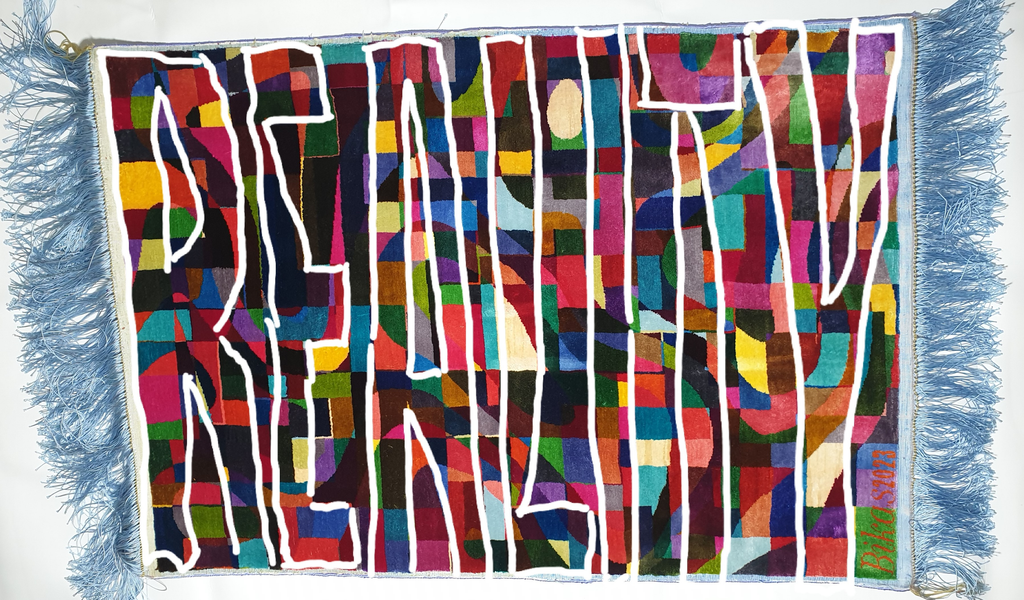
Hidden within the intricate geometric composition is a single word: REALITY.
The word does not immediately reveal itself. It is not presented as an obvious inscription or a decorative element intended to attract instant attention. Instead, it emerges gradually through careful observation. The viewer must look beyond the colourful surface, examine the relationships between the geometric forms, and discover the concealed message within the composition. What initially appears to be an abstract arrangement of interconnected shapes slowly transforms into a meaningful philosophical statement.
This deliberate concealment is central to the conceptual identity of the artwork. The hidden word represents the complexity of human existence and the continuous search for truth. Reality, much like the inscription woven into the rug, is not always immediately accessible. What appears obvious may be incomplete, while what remains concealed may contain the most significant meaning. The artwork therefore challenges the assumption that seeing is equivalent to understanding.
Beyond What the Eyes Can See
Human perception is often influenced by appearances, expectations, personal experiences, and established beliefs. We tend to accept what is immediately visible, interpreting the world through familiar patterns and preconceived ideas. However, appearances do not necessarily reveal the complete nature of things. Beneath the surface of ordinary experiences, there may be dimensions of existence that require deeper examination.
The Enigma of Reality translates this philosophical distinction into a visual experience. The viewer initially encounters a beautiful geometric composition, but the discovery of the hidden word changes the entire relationship with the artwork. The rug is no longer simply an arrangement of colours and shapes; it becomes a visual metaphor for the limitations of perception.
The act of discovering the word REALITY represents the transition from seeing to understanding. It reminds us that genuine comprehension requires more than observation. It demands curiosity, attention, critical thinking, and the willingness to question what initially appears self-evident.
In this sense, the rug becomes an exercise in visual awareness. It encourages viewers to reconsider their relationship with the world and recognise that the most meaningful discoveries often require looking beyond the obvious.
The Journey Towards Truth
The hidden inscription also symbolises the journey of human life. Every individual encounters obstacles, uncertainties, contradictions, and unexpected circumstances while attempting to understand the world and find personal meaning. The path towards truth is rarely direct or uncomplicated. It often involves questioning established assumptions, confronting uncomfortable realities, and navigating through layers of complexity.
The geometric patterns surrounding the concealed word can be interpreted as a metaphor for these challenges. Their intricate intersections and seemingly endless connections evoke the complicated nature of existence. Just as the viewer must carefully navigate the composition to identify the hidden message, individuals must navigate their experiences with patience and determination to approach a deeper understanding of reality.
The discovery is therefore as important as the destination. It is not simply about finding an answer; it is about developing the intellectual discipline and perseverance necessary to search for one.
The rug communicates an enduring message: truth should not be abandoned simply because it is difficult to discover. The apparent complexity of the world should not discourage inquiry, nor should uncertainty prevent us from pursuing understanding. Instead, obstacles can become opportunities for intellectual growth and deeper awareness.
Reality as a Personal Discovery
One of the most intriguing dimensions of this artwork is the role assigned to the observer. Unlike conventional visual compositions in which the artist communicates an immediately recognisable subject, The Enigma of Reality requires active participation.
The viewer is not merely looking at the artwork; the viewer is completing an intellectual journey within it. Each person may approach the composition differently, spending varying amounts of time examining its details before recognising the concealed word. The moment of discovery creates a personal connection between the observer and the artwork.
This experience raises another philosophical question: does everyone perceive reality in the same way?
Our understanding of the world is shaped by individual perspectives, knowledge, circumstances, and experiences. Two people may observe the same object yet interpret it differently. The rug reflects this complexity by presenting a message that exists within the composition but is not equally apparent to every observer at first glance.
Nevertheless, the artwork does not claim to provide a definitive philosophical answer to the nature of reality. Rather, it encourages an ongoing process of questioning. Its purpose is not to dictate what reality means, but to inspire the viewer to investigate the relationship between appearance, perception, and truth.
The Geometry of Complexity and the Harmony of Silk
The artistic language of The Enigma of Reality is inseparable from its material and craftsmanship. Created as a Persian full-silk rug, the artwork draws upon a centuries-old tradition of exceptional weaving, precision, and artistic discipline.
Silk provides a distinctive visual dimension to the composition. Its natural lustre interacts with light, allowing the colours and geometric details to reveal subtle variations depending on the viewing angle and surrounding illumination. This changing visual quality adds another layer to the artwork’s philosophical character: what we see is influenced not only by the object itself but also by the conditions through which we perceive it.
The intricate geometric arrangement demands exceptional technical precision. Every knot contributes to the continuity of the composition, while the relationship between colours and shapes maintains the visual coherence of the design. The craftsmanship is therefore not merely a means of producing an image; it is an integral part of the conceptual expression.
The transformation of an abstract philosophical question into a finely woven Persian silk artwork also creates a dialogue between tradition and contemporary conceptual art. An ancient medium becomes a vehicle for exploring one of humanity’s most enduring intellectual mysteries.
A Reflection on the Nature of Existence
Ultimately, The Enigma of Reality is an invitation to pause, observe, question, and discover. It reminds us that the world cannot always be understood through immediate appearances and that meaningful truths may require patience and determination to uncover.
The hidden word REALITY becomes a symbol of the human search for understanding: sometimes visible yet unnoticed, present yet concealed, waiting to be recognised through careful attention and persistent inquiry.
The artwork also offers a broader reflection on the relationship between knowledge and perception. Perhaps the greatest obstacle to understanding reality is not always the complexity of the world itself, but our tendency to accept the surface as the whole. By encouraging us to look deeper, the rug challenges this tendency and transforms observation into an act of intellectual exploration.
There is no final destination guaranteed in the search for truth. Every discovery may lead to another question, and every answer may reveal new dimensions that were previously unnoticed. Yet, the willingness to continue searching is itself an essential part of the human experience.
Reality is not always hidden because it is absent; sometimes, it remains undiscovered because we have not learned how to look.
Through the extraordinary craftsmanship of Persian full-silk weaving and the subtle language of geometric abstraction, Daniel Bikas transforms this timeless philosophical reflection into a tangible work of conceptual art. The Enigma of Reality is not merely a rug to be admired; it is a message to be discovered, a question to be contemplated, and a reminder that understanding begins when we dare to look beyond the surface.
Daniel Bikas
Pioneer Conceptual Persian Rug Artist
DanielBikas.com